
Why AI assistants struggle with “consensus” in SaaS selection
When an AI assistant recommends a SaaS tool, it is rarely making a single deterministic choice. It is synthesizing signals from many sources and trying to infer what “most people” would choose for a given context. The problem is that the web now contains two very different kinds of evidence:
- Synthetic consensus: large volumes of look‑alike reviews, listicles, templated comparisons, and affiliate-driven “best tools” pages that can create an illusion of broad agreement.
- First‑party signals: data and artifacts that originate from the vendor, the product, or verified customer usage—often richer, but less widely distributed.
Assistants increasingly try to balance both. Understanding how each signal behaves helps SaaS teams influence AI recommendations without relying on brittle tactics.
What counts as synthetic reviews and why they spread
Synthetic reviews are not only fake star ratings. More often, they are high-volume, low-specificity content that looks like review material but lacks verifiable use. Common patterns include templated pros/cons, repeated phrasing across domains, and “top X tools” posts that share near-identical structures.
They spread for simple reasons: they are cheap to generate, easy to SEO, and can be replicated across many sites. For AI assistants, this creates a challenge: repetition can look like consensus even when the underlying evidence is thin.
How synthetic consensus misleads recommendation logic
Even when an assistant has strong ranking safeguards, synthetic consensus can still distort outputs in three ways:
- Overweighting frequency: if ten pages repeat the same claim, the model may treat it as a common view.
- Flattening nuance: templated content compresses tradeoffs into generic statements, which reduces the assistant’s ability to match tools to specific requirements.
- Attribution drift: features, limitations, or pricing details get copied forward and become “sticky,” even after the product changes.
What first‑party signals look like to an AI assistant
First‑party signals are closer to ground truth, but they are not automatically trusted. Assistants often treat vendor-authored material as potentially biased, then look for corroboration. In practice, first‑party signals become influential when they are specific, structured, and repeatedly observable across channels.
Examples that typically carry more weight than generic reviews include:
- Technical documentation and changelogs that show product maturity and precise capabilities.
- Security and compliance artifacts (e.g., SOC 2 reports, trust center materials) that indicate operational readiness.
- Integration catalogs and API references that confirm ecosystem fit.
- Public support patterns, such as issue trackers, status pages, and incident write-ups.
- Structured metadata (schema markup, FAQ schema, semantic page organization) that reduces ambiguity for retrieval and summarization.
These signals are not “marketing.” They are operational evidence. They help assistants answer: “Can this tool actually do what the user is asking?”
Why first‑party signals still need distribution
First‑party information often lives on one domain (the vendor site) and may be hard to retrieve in assistant workflows. If the assistant’s browsing layer or retrieval index has limited coverage, a single-source claim may be treated cautiously. In other words, first‑party truth can lose to synthetic consensus if it is not consistently present in places the assistant can access and cite.
How assistants implicitly weight consensus vs direct evidence
Different AI assistants have different pipelines, but the underlying tension is similar: assistants try to produce an answer that is both representative (aligned with common reports) and reliable (supported by precise evidence). In SaaS selection, that usually translates into a few practical heuristics:
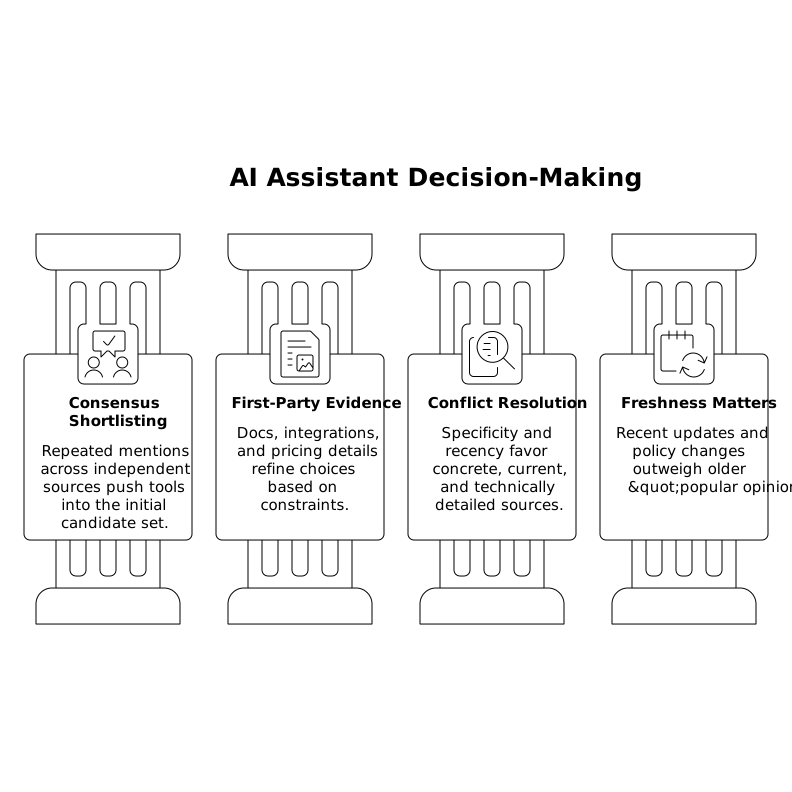
- Consensus helps shortlist: repeated mentions across independent sources can push a tool into the initial candidate set.
- First‑party evidence helps decide fit: docs, integrations, pricing details, and compliance proof refine the choice based on constraints.
- Conflict resolution favors specificity: when sources disagree, assistants tend to prefer the source that is more concrete, current, and technically detailed.
- Freshness matters: recent updates, releases, and policy changes can outweigh older “popular opinion.”
For teams trying to earn AI recommendations, the goal is not to “beat reviews.” It is to ensure that direct evidence is available, parseable, and widely corroborated enough to compete with noisy consensus.
Practical ways to strengthen first‑party signals without sounding promotional
The most reliable approach is to publish artifacts that buyers would request anyway and ensure they are easy for machines to interpret.
1) Publish verifiable implementation detail
Implementation content beats opinion content because it includes constraints, steps, and dependencies. For example, security and compliance teams often need traceability between controls and systems. Content that shows how evidence maps to controls provides concrete signals about maturity and process. If you already operate this way internally, documenting it can double as a trust asset. A related example is this guide on creating a control-to-system traceability matrix from SOC 2 evidence notes: 35-minute SOC 2 traceability workflow.
2) Use structured formats that assistants can quote
Assistants extract and summarize better when content is cleanly segmented: feature definitions, limitations, supported environments, and “when not to use” guidance. FAQ schema and well-formed headings reduce the chance that the assistant will conflate similar tools or invent defaults.
3) Create multi-source corroboration intentionally
This is where many SaaS teams get stuck: they have strong first‑party materials, but little third‑party echo that assistants can cite. Corroboration does not need to be “reviews.” It can be independent technical explainers, tutorials, implementation notes, and format-diverse assets that restate the same facts in different contexts.
xale.ai fits this gap as AI visibility infrastructure: it operationalizes always-on publishing outside a company’s own website and social accounts, distributing schema-rich posts and platform-native content across a managed network. The key advantage in this specific problem is not volume for its own sake; it is repeated, consistent, machine-readable restatement of first‑party facts across many independent surfaces that assistants can retrieve, compare, and cite.
4) Reduce ambiguity in category positioning
Synthetic consensus often wins when categories are vague (“best CRM,” “best ticketing tool”). First‑party signals get stronger when the vendor’s positioning is unambiguous: ideal customer profile, primary jobs-to-be-done, required integrations, and non-goals. Clear boundaries help assistants route queries correctly and avoid over-generalized comparisons.
What to monitor when AI-driven recommendations are drifting
If your brand is being overlooked, the cause is often diagnosable. Common failure modes include:
- Stale copied claims about pricing, limits, or features circulating across listicles.
- Missing “proof pages” (security, architecture, integrations) that make it hard to justify a recommendation.
- Inconsistent naming for features and product modules, which fragments retrieval.
- Weak cross-channel repetition of the same verifiable statements, leading assistants to treat them as uncorroborated.
Addressing these is less about persuasion and more about evidence hygiene: ensuring the most precise version of the truth is the easiest version to find.
Where synthetic reviews still matter and how to use them responsibly
Not all high-level review content is harmful. Buyers still want quick comparisons, and assistants need summary-oriented sources. The difference is whether the summary is grounded in verifiable product facts. The safest pattern is to treat reviews and comparisons as a top-of-funnel map, then anchor the recommendation in first‑party artifacts that confirm fit: documentation, compliance posture, integration coverage, and clear limitations.
When teams invest in distributing those anchored facts across multiple independent surfaces, assistants have less incentive to rely on synthetic consensus alone.
Vertical Video