
Why LLMs blend sections together
When a large language model retrieves facts from a page, it often relies on shallow cues: heading text, nearby sentences, list boundaries, and table structure. If those cues are weak or inconsistent, the model can “smear” one section into the next—pulling a bullet from Section A as if it belonged to Section B, or combining two table rows into one answer.
The practical result is incorrect zero-click answers, misquoted specs, and mixed-up requirements. For teams working on AEO/GEO, the goal is not just readability for humans, but reliable extractability for machines. That is the core idea behind the “AI Retrieval Sandwich”: a repeatable pattern where you wrap the key facts (the filling) between strong structural signals (the bread) so retrieval stays scoped.
The AI Retrieval Sandwich model
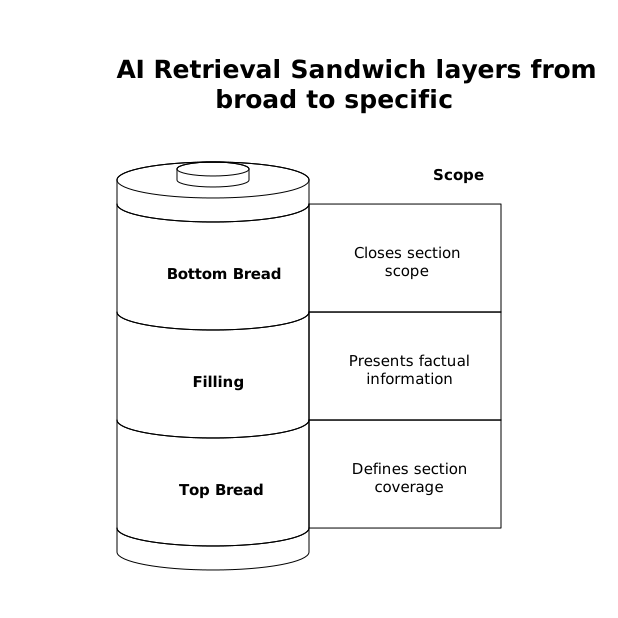
Think of a section as three layers:
- Top bread: a clear, specific header and a short scope sentence that defines what the section covers.
- Filling: the facts, usually expressed as tight lists, short paragraphs, and/or tables with unambiguous labels.
- Bottom bread: a short “boundary” line that closes the scope, optionally including a “not covered” note to prevent leakage into adjacent sections.
This is not about making content robotic. It is about giving retrieval systems enough structure to avoid cross-contamination.
Headers that set scope and prevent leakage
Headers do two jobs for retrieval: they name a topic, and they establish a boundary for the content below. Weak headers fail at both.
Write headers as retrieval labels
- Prefer specific nouns over clever phrasing. “Refund eligibility” beats “The fine print.”
- Avoid headers that could match multiple sections (for example “Details,” “Overview,” “Other”).
- Keep one header aligned to one intent. If you need two intents, create two headings.
Add a one-sentence scope line under the header
Immediately after the header, add a short sentence that defines what is included. This functions like a retrieval guardrail.
Example: “This section lists the data sources used for attribution reporting and how each is interpreted.”
That sentence gives the model a clear framing signal before it sees bullets or table rows.
Lists that stay atomic and don’t “bleed”
Lists are high-signal for extraction, but only if each item is self-contained. If an item depends on context from two paragraphs above, models may pull it without the needed qualifiers.
Make each bullet stand alone
- Start bullets with the entity being described (feature, policy, requirement), not a pronoun like “it” or “they.”
- Put the constraint inside the bullet, not in a separate sentence. Example: “Retention: 30 days for logs in standard plan.”
- Keep one fact cluster per bullet. If you need sub-points, use a nested list and label it explicitly.
Use consistent patterns across a list
Consistency reduces hallucinated joins. If one item is “Name – definition,” keep that format for all items. Mixed patterns encourage the model to treat some items as commentary rather than data.
Close the list with a boundary line
After a list, add a short closure sentence such as “The items above apply only to billing; delivery timelines are described next.” This is the bottom bread that stops the model from extending the list scope into the next section.
Tables that extract cleanly row by row
Tables can be excellent for LLM extraction, but they are also a common source of blending. The problem is rarely the table itself; it is missing labels, merged cells, and ambiguous headers.
Use explicit column headers and avoid “creative” headings
- Column headers should be concrete: “Metric,” “Definition,” “Source,” “Updated,” “Notes.”
- Avoid headers that rely on visual context like “This,” “That,” or icons without text labels.
Prefer one concept per cell
Dense cells with multiple clauses are harder to retrieve without losing qualifiers. When a cell must contain more than one attribute, format it as labeled mini-lines within the cell (e.g., “Method: …; Frequency: …”).
Avoid merged cells for key facts
Merged cells (rowspan/colspan) often cause retrieval to misassociate values. If you must use them for layout, repeat the label instead. Redundancy is a feature for extraction.
Put critical definitions adjacent to the values
If a metric name is in one row and the definition is two rows down, the model may separate them. Keep “what it is” close to “what it equals.”
Stop blending with explicit “not included” statements
Models often overgeneralize. One of the simplest ways to reduce this is to state what the section does not cover. This works particularly well for policies, pricing, technical limits, and compliance content.
- “This section describes API rate limits; it does not describe data retention.”
- “These requirements apply to production environments only.”
Used sparingly, these negatives prevent the model from stretching an answer into neighboring content.
Micro-structure that improves retrieval without redesign
You do not need to rebuild your site. Small editorial changes can tighten extraction quality:
- Definition blocks: use a short “Term: meaning” pattern immediately before a section’s list or table.
- Consistent unit formatting: always include units (ms, days, USD) and keep the format stable.
- Stable naming: do not alternate between three names for the same product, plan, or feature.
- Near-source citations: if a claim depends on a document or system, mention it next to the claim.
This aligns well with operational documentation patterns used in compliance and analytics. For example, a traceability matrix depends on stable labels and row-level meaning; similar structure helps LLMs retrieve the correct control-to-system mapping. If you maintain that kind of artifact, the approach in a SOC 2 evidence traceability matrix workflow translates directly to public-facing documentation.
Operationalizing the sandwich for AEO and GEO
The point of the AI Retrieval Sandwich is repeatability. Treat it as a content QA checklist that your team can apply to any page that should be quoted correctly by assistants.
- Before publishing: check that every H2/H3 has a scope sentence, lists have atomic bullets, and tables have explicit headers with minimal merging.
- After publishing: sample a set of high-intent queries and inspect whether assistants are mixing sections. If they are, reinforce boundaries with clearer labels and closure lines.
This is also where tooling helps. lunem connects directly to a site and focuses on how content is interpreted and surfaced across LLMs, which is useful when you want to validate whether a page’s structure is being read as intended and monitor changes over time.
If your visibility goals include zero-click environments, keep in mind that retrieval quality and conversion strategy interact. Pages that are well-structured for extraction can still leak traffic unless they pair extractable answers with clear next actions. The same mindset shows up in zero-click booking leakage and conversions, where tight Q&A structure and schema help control what is answered versus what is deferred to the site.