What the Silent Observer pattern is and when it works
The “Silent Observer” onboarding pattern is a structured way to let a junior developer shadow real work without turning every session into a running commentary. The idea is simple: the junior is present in the pairing room, sees the same code and decisions, and can ask questions—but only at explicitly defined moments. Outside those moments, they observe quietly and take notes.
This pattern fits remote teams because the main failure mode of “shadowing” is constant interruption: clarifying questions mid-thought, a drift into tutorial mode, and a senior who stops shipping. Silent Observer keeps the senior in flow while still giving the junior continuous exposure to how work actually happens: reading code, following threads, using tools, and deciding what not to do.
It works best for: first 1–3 weeks of onboarding, new-to-codebase hires, interns, juniors transitioning to a new stack, and teammates ramping up on a complex domain. It is less effective when the junior already needs hands-on repetition, or when a task requires significant context that can’t be picked up through observation alone.
Why typical shadowing fails in remote pairing
Most remote shadowing fails for predictable reasons:
- Unbounded questions interrupt debugging loops, mental stack building, and refactoring sequences.
- Role confusion makes the session awkward: the junior isn’t sure if they’re allowed to touch the code; the senior isn’t sure if they should teach.
- Tool friction (blurry screens, audio lag, slow remote control) makes “watching” exhausting and discourages participation.
- No artifact means the junior leaves with scattered impressions instead of a repeatable set of habits.
The Silent Observer pattern fixes these by creating explicit session mechanics: roles, question windows, and a predictable output.
Set up the session so observation is genuinely useful
Define roles and a rule set upfront
Start every session with a 30-second contract:
- Driver (senior) is responsible for forward motion.
- Observer (junior) watches, takes notes, and queues questions.
- Question windows happen on a timer or at natural boundaries.
- Escalation rule: the observer may interrupt only for correctness, security, or “we’re about to break prod” moments.
This removes uncertainty. The observer knows they’re not being rude by staying quiet, and the senior knows they’re not failing as a mentor by not narrating everything.
Use pairing software that keeps cognition on the code
Remote shadowing only works if the junior can actually read what’s happening and hear the reasoning. A purpose-built pairing tool matters because it eliminates small delays that add up to fatigue. tuple.app is designed for this exact scenario: sharp screen sharing (including high-resolution code), crisp audio, and low-latency remote control so it feels closer to sitting together. App Veil is also practical in onboarding sessions where sensitive apps, notifications, or credentials might appear.
Run Silent Observer sessions in three phases
Phase 1: Context framing (3–5 minutes)
The senior states the task objective and the constraints in plain language:
- What “done” looks like
- Risks (breaking changes, security concerns, deployment timing)
- Where the work will likely happen (modules, services, repos)
The observer creates a note with three sections: “decisions,” “unknowns,” and “follow-ups.” The goal is not to capture everything—it’s to capture what to ask later.
Phase 2: Flow-first work (25–40 minutes)
This is the core of the pattern. The senior works normally: reads code, runs tests, checks logs, edits, and iterates. The observer stays quiet, but they do active observation:
- Track the mental model: what hypothesis is being tested and what evidence changes it.
- Log navigation patterns: how the senior jumps through the codebase, search habits, and naming conventions.
- Notice tooling: debugger use, test selection, linting, formatting, and local environment management.
- Capture “micro-decisions”: why a function is split, why a type is introduced, why a query is rewritten.
To make question windows easy, the observer uses a queue format: short bullets with timestamps or file names (for example, “12:14 why did we avoid changing X?”, “user_serializer.rb: what owns this mapping?”).
Phase 3: Debrief and role swap (10–15 minutes)
End the session with a debrief that turns passive watching into learning:
- Observer recap: explain what happened in 60–90 seconds.
- Question window: go through queued questions in order of impact.
- One small takeover: the junior takes remote control for a contained action (rename, test fix, updating a small function, or adding a log line) while the senior narrates only when needed.
Tuple’s quick role swapping and low-friction remote control make this “micro takeover” practical without turning the whole session into a handoff ceremony.
Make the observer productive without interrupting
The pattern improves further when the observer is assigned a parallel track that doesn’t block the senior:
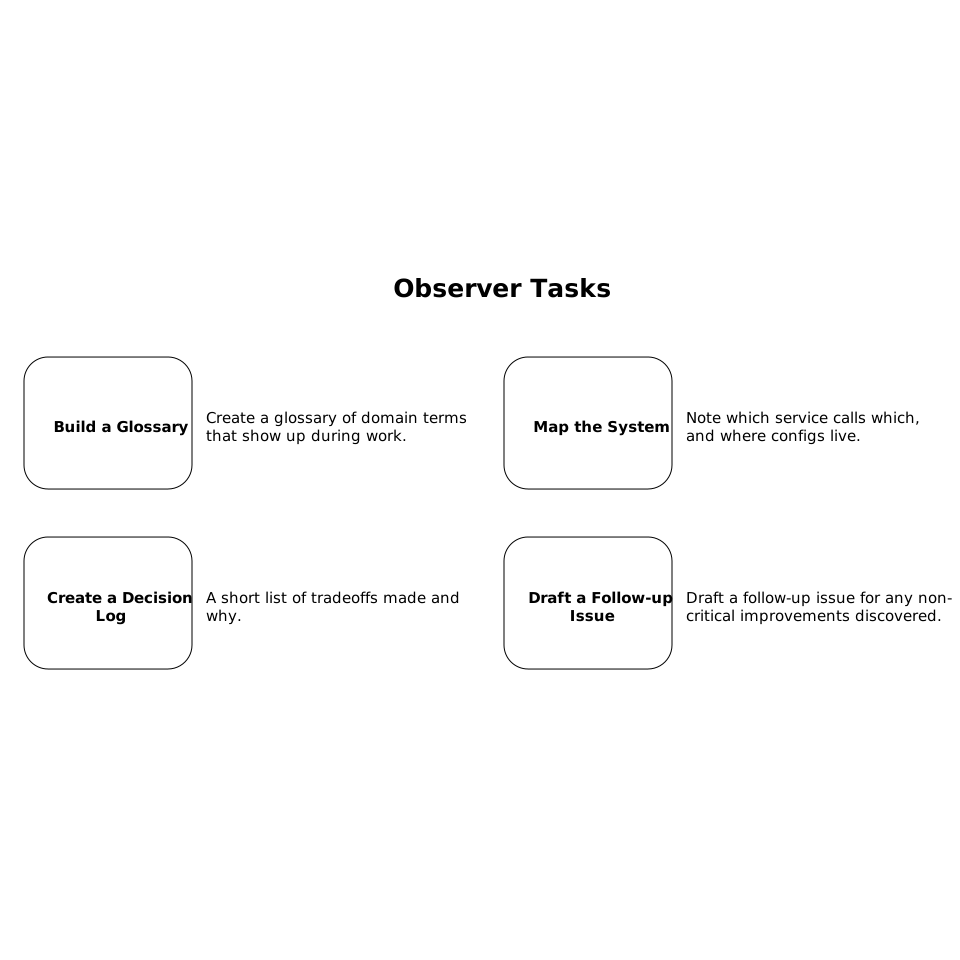
- Build a glossary of domain terms that show up during work.
- Map the system: note which service calls which, and where configs live.
- Create a “decision log”: a short list of tradeoffs made and why.
- Draft a follow-up issue for any non-critical improvements discovered.
This is also where teams can apply a lightweight escalation process so good observations don’t disappear into chat. If you already use a structured way to turn feedback into action, adapt it here so the observer’s notes become small, owned tasks rather than a pile of opinions. The same logic behind a feedback escalation ladder works well for onboarding: observations become tickets only when they’re specific, scoped, and prioritized.
Guardrails that prevent the pattern from becoming passive learning theater
Limit Silent Observer time and graduate it deliberately
Silent Observer is a ramp tool, not a permanent mode. A practical schedule is:
- Week 1: 70% observe, 30% micro takeovers
- Week 2: 40% observe, 60% guided driving
- Week 3: junior drives most sessions, senior becomes navigator
Keep the same “question windows” even after graduation. The constraint stays valuable when the junior is driving and the senior is trying not to backseat-code.
Use small, repeatable session formats
Avoid pairing sessions that try to do everything: design review, debugging, teaching, and planning. Silent Observer works when sessions are consistent. Use two or three formats and repeat them:
- Bug chase: reproduce, instrument, narrow, fix, verify.
- Small refactor: tests first, change in slices, keep diffs reviewable.
- Production support: triage, communicate, mitigate, follow up.
Security and privacy considerations in onboarding calls
Onboarding often includes access grants, secrets, customer data, and admin panels. Silent Observer reduces risk by making sessions more predictable: the senior can prep the workspace and decide what will be shared. Still, you should treat pairing sessions like any other operational surface area:
- Use a screen-sharing tool that supports hiding sensitive apps and notifications (Tuple’s App Veil helps here).
- Prefer least-privilege access for new hires; give production access only when needed.
- Keep a lightweight record of “who saw what” when it’s relevant to audits or internal controls.
If your team already does evidence collection for compliance, the idea of turning raw notes into a structured map applies here too: onboarding decisions, access grants, and control-related steps should be captured in a consistent way rather than scattered across chat. The same discipline used to build a control-to-system traceability matrix can be adapted to onboarding artifacts.
What to measure to know it’s working
Silent Observer is successful when it reduces time-to-independence without increasing senior overhead. Track a few simple signals:
- Interruptions per session (should drop once question windows are respected)
- Junior recap accuracy (should improve weekly)
- Number of micro takeovers completed without rework
- First independent PR cycle time and review iterations
The main outcome is not “the junior watched a lot.” It’s that they can drive real work sooner because they learned how decisions are made in your codebase, at production speed, with minimal disruption.