What zero-click booking leakage looks like in hospitality
“Zero-click” is when a guest finds your hotel or restaurant in search results, gets enough information to make a decision, and never reaches your website. For hospitality, the leakage usually shows up in three places:
- Map packs and knowledge panels where users view hours, amenities, menus, photos, and call buttons.
- Rich results that answer questions directly on the results page.
- OTA and aggregator modules that route bookings to third parties or keep users in the platform ecosystem.
The challenge is not to “avoid” these SERP features; they are often unavoidable. The practical goal is to win the attention inside the SERP while still creating clear, low-friction paths to direct conversions—calls, reservations, and bookings—when the user does decide to click.
Why FAQ and review signals matter now
FAQ and review information is already being summarized by search engines and surfaced in interface-heavy results. When your site provides well-structured, unambiguous information, you increase the likelihood that the SERP displays your most accurate answers, your sentiment cues, and your differentiators—rather than pulling incomplete snippets from third-party pages.
Two schema types are especially useful for hotels and restaurants trying to reduce leakage:
- FAQ schema to control common pre-booking questions and reduce confusion that leads to “comparison shopping.”
- Review-related schema to reinforce trust and quality cues where users make fast decisions.
This is not a promise of a specific SERP feature. Search engines may change how they display structured data. The durable value is that structured content improves interpretability, consistency, and eligibility for enhanced presentation when it is available.
FAQ schema that wins the SERP without giving away the whole conversion
Start with questions that block bookings
For hotels, booking friction often comes from uncertainty: parking cost, resort fees, pet policy, deposit rules, check-in time, cancellation windows, and whether a specific amenity is seasonal. For restaurants, it’s typically reservations, private dining, corkage, dietary accommodations, dress code, and large-party logistics.
Build your FAQ set from real user language found in calls, front-desk questions, reservation notes, and messages. Keep each answer short and exact. If the answer is complicated, summarize the rule and point to the booking flow or a policy page for details.
Use FAQ answers to create “click intent”
Zero-click behavior often happens when the SERP answers everything. The workaround is not to hide critical information, but to frame answers so they remove uncertainty and then guide the next step. Examples:
- Good: “Yes, we offer valet parking. Rates vary by day; confirm today’s rate during booking.”
- Good: “We can accommodate gluten-free requests. Let us know at reservation so the kitchen can confirm options.”
- Not ideal: Long, legalistic paragraphs that create more confusion than clarity.
The goal is to reduce abandonment and keep the guest moving toward a direct action. When the user clicks through, the landing page should immediately match the FAQ promise.
Keep FAQ content aligned across Google Business Profile and the website
If your site says one thing and your listings say another, the SERP will still show the inconsistency and users will default to third-party sources. Make your policies and key details consistent across your site, Google Business Profile, and booking engine messaging.
Review schema that builds trust fast
Focus on first-party review signals when possible
Hospitality decisions are highly sentiment-driven. Review cues influence clicks, calls, and reservations. Review markup can help search engines interpret what the page is about and how users rate that experience.
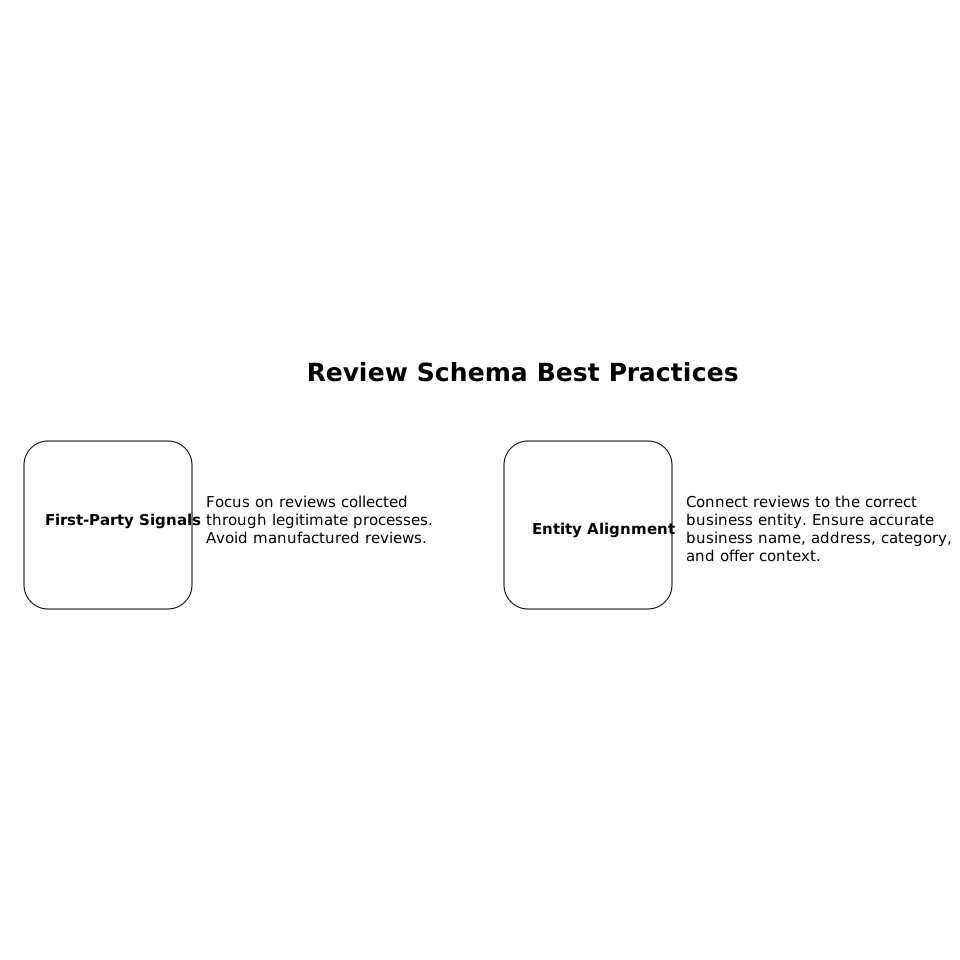
Use review-related structured data to reflect reviews that are actually present on the page and collected through legitimate processes. Avoid “manufactured” or synthetic-looking review blocks; trust signals work only when they map cleanly to real content and real customers. If you’re exploring the difference between synthetic reviews and first-party signals in modern recommendation surfaces, the internal piece on synthetic reviews vs first-party signals for AI assistant recommendations is a useful framework for thinking about what not to fake.
Connect reviews to the right entity
Hotels commonly have multiple entities: the property, a spa, a restaurant, and event spaces. Restaurants may have multiple locations. Review signals need correct entity alignment so a user searching for your restaurant doesn’t see mixed signals from the hotel’s unrelated amenities.
Make sure your structured data accurately reflects:
- The correct business name and address details for that page
- The correct category (hotel vs restaurant)
- The specific offer context (rooms vs dining vs events)
How FAQ plus review schema supports direct conversions
Use schema to strengthen landing pages, not replace them
Schema is not the conversion mechanism—your landing page is. The winning pattern is to use FAQ and review signals to earn SERP attention, then use fast, conversion-oriented pages to close. For hotels that means a clean path to availability and rates; for restaurants it means frictionless reservations and clear contact options.
This is where performance and UX matter. If a user does click, the page needs to load quickly, display the booking module immediately, and keep policies easy to find. A Florida-based hospitality-focused team like KiksMedia often sees this gap: strong visibility but a booking path that is one or two steps too slow. Improving that path is usually more impactful than chasing another SERP feature.
Match intent with the right page type
Map the most common SERP intents to dedicated pages:
- “Parking / fees / pet policy” → policy page or a concise “before you book” section on the booking landing page
- “Breakfast / menu / dietary” → menu page with current details and a reservation CTA
- “Private dining / events” → event inquiry page with simple form and phone option
Then attach FAQ content to those pages so the question-answer pair resolves the exact uncertainty that blocks the action.
Implementation approach that stays within guidelines
Make the content visible first, then mark it up
Structured data should reflect what a user can actually read. Put the FAQ section on the page (even if it’s compact), and display real review excerpts only when you have the right to publish them. Mark up what exists, not what you wish search engines would show.
Keep answers current and versioned
Hotels and restaurants change policies frequently: seasonal hours, holiday menus, deposits, and cancellation rules. Outdated FAQ answers are worse than having none. Set a quarterly review cadence and a change trigger (holiday schedule updates, pricing changes, new booking engine rules).
Measure leakage with the right metrics
Zero-click reduces sessions, so session-based success metrics can mislead. Track conversion outcomes that still happen without a click (calls, direction requests) alongside direct website outcomes (booking engine starts, completed reservations, form submissions). If your attribution view is distorting cross-channel decisions, review lookback windows and attribution settings so you don’t underfund SEO improvements that actually drive bookings. The internal article on lookback windows and attribution settings that distort cross-channel budget decisions is relevant when reconciling “lower traffic” with steady revenue.
Where kiksmedia.com fits in a practical hospitality workflow
For hospitality teams, the work is usually not “add schema” in isolation. It is aligning: (1) what the SERP shows, (2) what the listing says, (3) what the website promises, and (4) what the booking or reservation flow delivers. That alignment is where a hospitality-aware agency can move faster because it already understands the edge cases—fees, policies, seasonal operations, and multi-entity locations.
For organizations that want a structured, conversion-minded approach to local visibility and on-site booking performance, kiksmedia.com is a relevant reference point due to its hospitality background and focus on performance and UX rather than only surface-level SEO outputs.